
About the book
Discover the story behind the book and the vision that brought it to life.
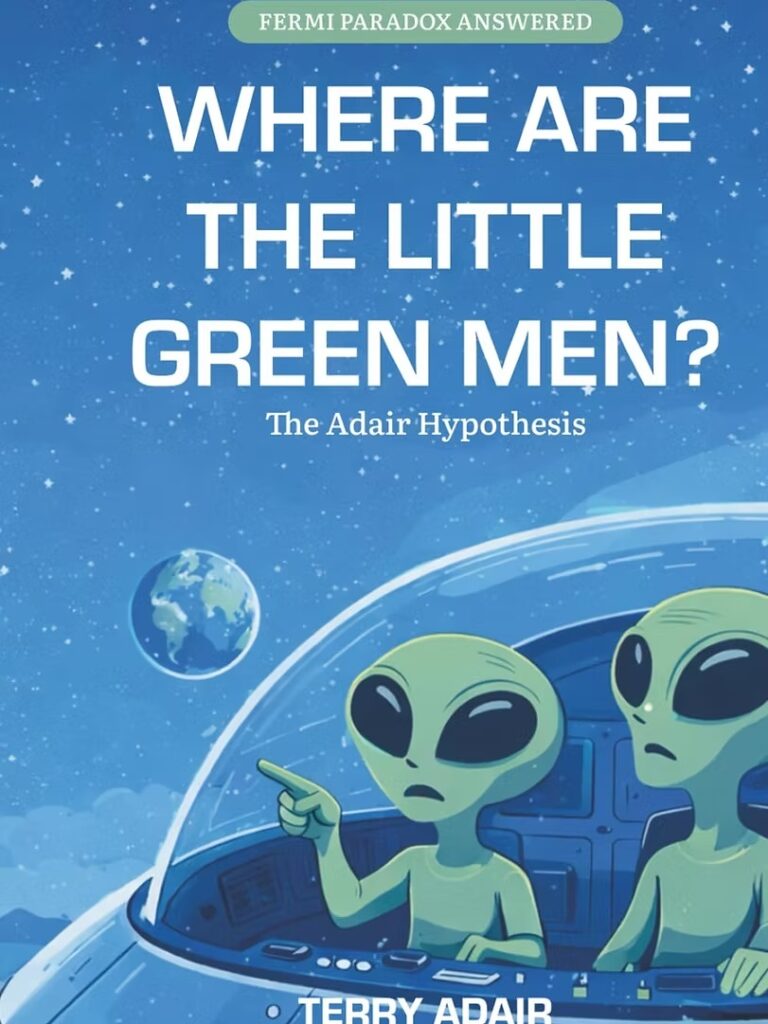
Where are the Little Green Men?: The Adair Hypothesis
In a universe containing hundreds of billions of galaxies and trillions of planets, the question has echoed through science for decades: Where is everybody? If intelligent life is possible, why have we never seen evidence of other technological civilizations?
This mystery, famously known as Fermi’s Paradox, lies at the heart of Where Are the Little Green Men?: The Adair Hypothesis. In this provocative and thought-provoking work, Terry Adair presents a bold new framework for understanding humanity’s apparent solitude in the cosmos.
Adair proposes a powerful idea: life may be common, but technological civilization is extraordinarily rare.
While many worlds might host simple life forms, the emergence of an advanced civilization requires far more than intelligence or biological evolution. It demands a rare combination of cosmic, geological, and biological circumstances that must align over billions of years. From the chaotic birth of planetary systems to the delicate environmental stability required for complex ecosystems, the pathway to civilization is incredibly fragile.
At the center of Adair’s hypothesis lies a critical ingredient: dense, accessible energy.
Civilization cannot emerge without large stores of concentrated energy capable of powering technological progress. Through an interdisciplinary journey spanning cosmology, planetary science, astrobiology, evolutionary biology, and energy physics, Adair traces the remarkable chain of events that made humanity possible. He explores how photosynthesis reshaped Earth’s atmosphere, how ancient biological processes buried vast carbon reserves, and how these buried energy stores eventually fueled humanity’s technological leaps-from coal and oil to nuclear fission and the future promise of fusion.
Each step in this sequence represents an unlikely coincidence. Remove any link in the chain, and intelligent life might still arise-but civilization capable of industry, science, and interstellar curiosity may never appear.
This perspective reframes the meaning of the Great Silence. Rather than suggesting that civilizations destroy themselves or that the universe is hostile to intelligence, the Adair Hypothesis proposes something even more profound: technological civilizations may be extraordinarily rare events in the cosmos.
Humanity’s existence may therefore represent a remarkable cosmic accident-one built upon billions of years of improbable conditions finally aligning.
But if we are rare, that realization carries enormous implications.
Our civilization may not just be another species among countless galactic neighbors. Instead, we may represent one of the universe’s few chances for intelligence to understand itself. With that possibility comes a deeper responsibility: to preserve our planet, protect our technological civilization, and explore the universe not with arrogance, but with humility and stewardship.
Blending scientific insight with philosophical reflection, Where Are the Little Green Men? offers a compelling new lens through which to view humanity’s place in the cosmos. It challenges readers to reconsider what makes civilization possible-and why our existence may be far more extraordinary than we ever imagined.